

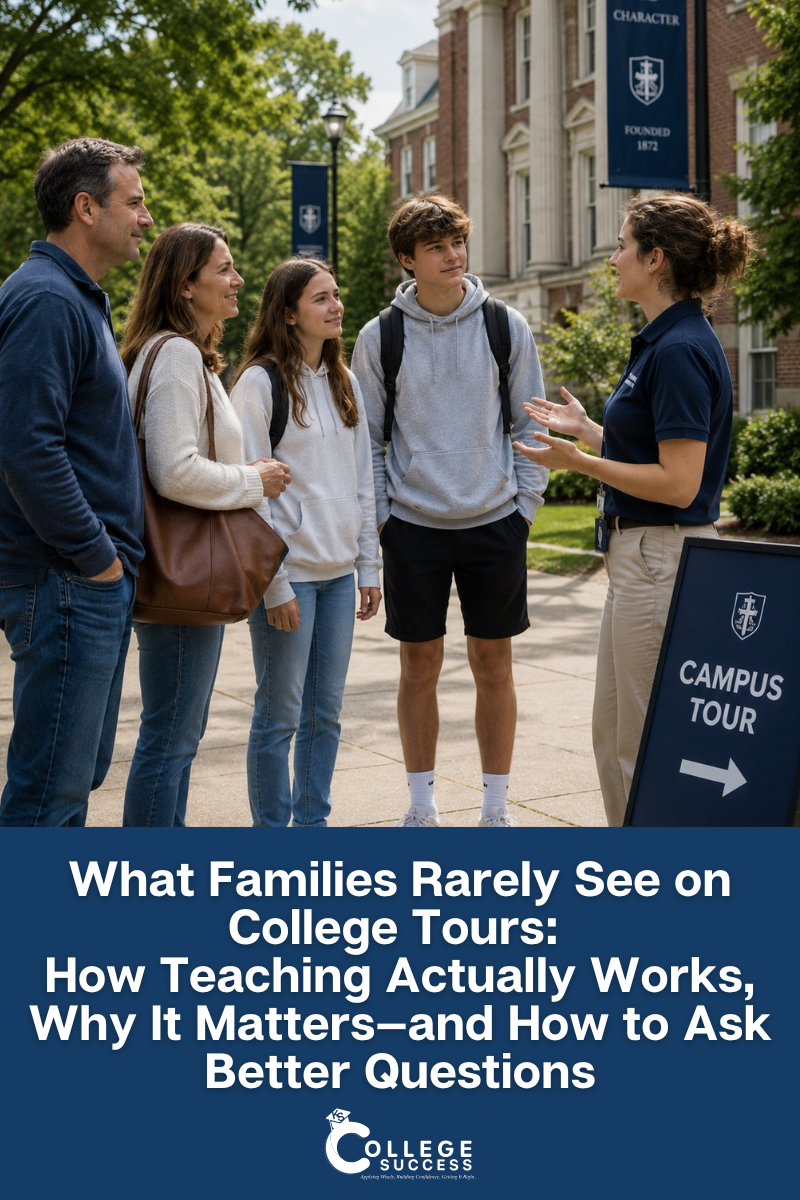
14 Jun What Families Rarely See on College Tours: How Teaching Actually Works, Why It Matters—and How to Ask Better Questions
When families visit college campuses, the experience is carefully curated. Tours highlight residence halls, dining facilities, research labs, athletic complexes, and student life spaces. What families almost never see is the part of college that most directly shapes a student’s intellectual growth: the classroom.
This omission is not intentional deception; it is structural. Teaching happens behind closed doors, varies by discipline, and is difficult to summarize in a soundbite. Yet decades of higher-education research show that how students are taught has a greater impact on persistence, learning, and long-term outcomes than many of the metrics families are encouraged to prioritize.
Why Teaching Quality Is Difficult to Identify
Unlike admissions statistics or post-graduation outcomes, teaching quality is not easily quantified. Colleges rarely publish meaningful data on pedagogy, course design, or learning assessment. Families are left to rely on proxies—student-faculty ratios, faculty credentials, or reputational rankings—that reveal little about what students actually experience day to day.
Even well-intentioned conversations with current students can be misleading. Students often evaluate courses based on enjoyment, grading leniency, or instructor personality, not on whether the course promoted deep learning or intellectual growth. As a result, families may leave visits with strong impressions of campus culture but very limited insight into academic rigor or instructional quality.
Faculty Structure and Its Impact on Learning
One of the most misunderstood aspects of undergraduate education is faculty structure. Most institutions employ a mix of tenured faculty, tenure-track faculty, teaching-track faculty, adjunct instructors, and graduate teaching assistants. Each group operates under different expectations, incentives, and constraints.
This structure matters because:
- Teaching loads vary widely.
- Job security can affect course continuity and availability.
- Institutional incentives often prioritize research productivity over teaching excellence.
Importantly, faculty title alone does not predict teaching quality. Some of the most engaging and innovative instructors are early-career or teaching-focused faculty, while some highly accomplished researchers may devote less attention to undergraduate pedagogy. The issue is not who is teaching, but whether teaching is supported, valued, and intentionally designed.
Families often assume that introductory courses—the gateway to many majors—are taught by the institution’s most experienced professors. In practice, those courses are frequently assigned to instructors with the heaviest teaching loads and the least institutional support. Because early academic experiences play a critical role in student retention and confidence, understanding who teaches these courses and how they are structured is particularly important.
Why Teaching Quality Matters for Persistence and Academic Confidence
For many students, the first year of college is not simply an academic transition—it is a test of belonging. Introductory courses often serve as gateways to majors, yet they are also where students are most vulnerable to disengagement.
Research consistently shows that early classroom experiences influence whether students persist, change majors, or leave an institution altogether. When courses are poorly structured, overly passive, or disconnected from students’ prior preparation, students are more likely to interpret difficulty as a personal failure rather than a normal part of learning.
This is especially consequential in the first two years of college, when:
- students are adjusting to higher expectations and independence,
- academic confidence is still forming,
- and access to faculty guidance can determine whether a student seeks help or disengages.
Strong teaching mitigates these risks. Courses with clear learning objectives, scaffolded assignments, and active engagement help students understand how to learn—not just what to memorize. Faculty who are accessible outside the classroom normalize help-seeking behavior and reinforce that struggle is part of intellectual growth.
Conversely, when students encounter large, impersonal courses with limited feedback and minimal faculty interaction, they are more likely to:
- disengage from a subject they may have otherwise pursued,
- abandon intended majors prematurely,
- or question whether they belong in college at all.
Persistence, then, is not just about grit or motivation. It is deeply shaped by instructional design, faculty accessibility, and departmental culture—all of which students can begin to assess during the college search process if they know where to look.
What Effective Teaching Actually Looks Like
Across disciplines and institution types, research on undergraduate learning converges on a set of consistent principles. Effective teaching is characterized by:
- Active engagement rather than passive listening
- Opportunities for students to apply concepts to real-world contexts
- Clear learning objectives that build over time
- Assessment methods aligned with those objectives
- Classroom environments that foster belonging and participation
These practices are not dependent on class size or prestige. Large lectures can be designed to engage students meaningfully, and small seminars can fall flat if poorly structured. What distinguishes strong programs is not scale, but intentional pedagogy and faculty preparation.
The Department Perspective Families Rarely Hear
During a professional discussion on undergraduate teaching, a department head offered an illuminating observation: thoughtful, specific questions about teaching and learning are not only appropriate—they are welcome.
From that department’s perspective, questions such as the following signal seriousness rather than skepticism:
- What is the balance between full-time and part-time faculty in the department?
- Do full-time faculty teach introductory courses?
- How accessible are faculty outside of class?
- Do faculty members serve as academic advisors?
- What are the learning objectives of the major?
- What do typical assignments and assessments look like?
- How does the department evaluate teaching effectiveness and student learning?
This viewpoint is important because many students hesitate to ask these questions, worried they may appear confrontational or uninformed. In reality, such questions demonstrate intellectual curiosity and an understanding that learning is shaped by structure and design, not just institutional reputation.
Why Department-Level Inquiry Matters
Teaching quality often varies more within institutions than between them. Two students at the same university can have dramatically different academic experiences depending on their department, course sequence, and access to faculty mentorship.
For students who have identified potential academic interests—even tentatively—direct engagement with departments provides far more insight than generalized admissions presentations. Reviewing course descriptions, understanding assessment practices, and learning how faculty interact with undergraduates can reveal whether a program is aligned with a student’s learning style and goals.
A Shift in How Families Think About College Fit
College fit is often discussed in terms of size, location, social environment, and outcomes. Academic fit deserves equal attention. This does not mean families need to interrogate institutions or demand guarantees. It means learning to ask better questions—questions that move beyond marketing and toward the lived academic experience.
The goal is not to find a college with “perfect” teaching. It is to identify environments where teaching is taken seriously, learning is thoughtfully designed, and students are supported as they navigate intellectual challenges.